

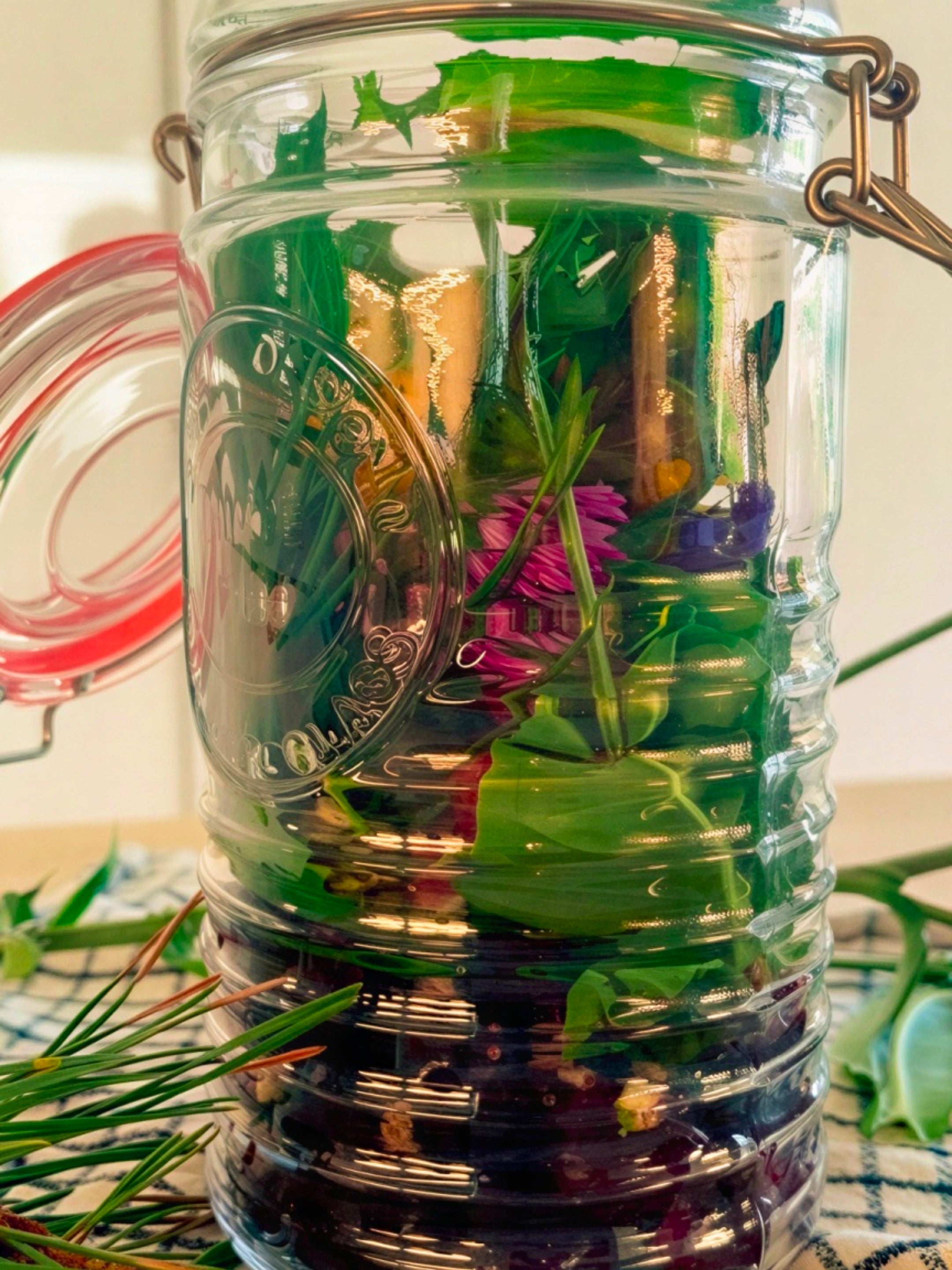
On July 17, during a stretch of hot, dry weather in Ottawa, I went looking for the flavours of midsummer. My goal was to collect a bouquet of wild flavours for the first stage of a seasonal amaro: an experiment in capturing what was growing here during one particular week in July.

A small midsummer harvest from Ottawa, prepared for the first stage of alcohol extraction.
Field details
Place: Wild urban parks and places around Ottawa, Ontario
Harvested: July 17, 2026
Conditions: Hot and dry
Activity: Foraging and botanical alcohol extraction
Season: Midsummer
Status: Experiment in progress; first tasting after a minimum of five weeks
What you should know
This is not a finished summer amaro recipe. It is the first field report from an experiment built around plants growing in and around Ottawa in mid-July. I weighed each ingredient, covered the mixture with a neutral 76% spirit and sealed the jars for extraction. The final flavour and blend are still to be decided - midsummer plants are still popping around here, and I may add some new flavours in the coming weeks depending on what’s available for harvesting. I’m also still searching for and deciding on what white wine I’ll use in the final steps to bring the alcohol down and make this into a drinkable summer Amaro. I will publish the measured recipe only if the finished amaro proves worth repeating. It’s all an experiment in wild foraging and capturing the essence of the wild, beautiful places that I love.
From the field: Ottawa’s midsummer bitterness
Foraging is really about connecting with your local landscape and environment: knowing what is in season, where to find it, and spending the time looking for things and collecting them responsibly (and, importantly, knowing what is safe).
Ottawa is full of wild places hiding inside the city: parks, the sides of pathways, meadow edges and untended wild corners where useful plants often grow in abundance and hidden in plain sight. Hidden Harvest Ottawa has built an entire community program around a similar idea, organizing volunteers who harvest and share fruit and nuts from registered trees around the city that might otherwise go unused.
My foraging was small. I was looking for just a few plants for a batch of summer amaro I had in mind. A few flowers here. Some berries and pine needles there. Enough to begin an experiment without taking much from any one plant or place.
My goal was to collect a bouquet of wild flavours: sumac, chicory, red clover, dandelion and pine gathered around Ottawa, plus cherries from out West and some basil and basil flowers from plants growing in our backyard. Our flower beds and gardens are planted with native species, so we keep herbs like basil and mint in pots to stop them from taking over.
This wild-foraged summer amaro is not a finished recipe… not yet. But it is a record of what was growing here during one particular week in July and what I decided to do with it.
Like everything else in the Lodestar Backcountry Provisions collection, this is fundamentally about capturing the experience of wild places in different ways. The aim is to make something delicious and useful, but also to move further into the sensory experience of being there on this hot day in July. A way of capturing that vibe, that moment in time, in a way that goes beyond photos and videos.
I had spent several days that week hiking on the Quebec side near L’Ange-Gardien, Bowman, Val-des-Bois and Denholm. Driving the backroads and hiking the trails, I could see that the roadsides and open fields were full of sumac, chicory, dandelion and clover.
Back in Ottawa, the same pattern of seasonable plants popping was easy to see.
Sumac is everywhere right now. Its berry clusters are turning a deep red and developing the tart, lemony flavour that makes it useful in drinks, syrups and seasoning. A good cluster tastes bright, sour and lightly astringent. That flavour, tartness but not bitterness alone, is the field clue you’re looking for to know if it’s ready. The sumac I harvested had a lovely lemony flavour that should add some useful acidity to the amaro.
Dry weather helps, too: rain can wash some of the surface acidity from the fruit. Collecting on a hot summer day after a long dry period felt like a sweet spot.
Chicory brings a different kind of bitterness. Its blue flowers appear all summer along sunny, disturbed ground, while its leaves and roots have a long culinary history. The leaves are naturally bitter and can be cooked to soften that edge; the dried, roasted root is commonly used as a coffee-like ingredient. For this extraction, I did not want chicory as a headline flavour, though. I wanted it as one layer of the bitter structure underneath everything else.
Dandelion changes as the season moves. Young flowers can taste almost honeyed; older flowers and leaves become more assertively bitter. That makes midsummer dandelion useful here, not because it will dominate the jar, but because it adds another local layer to the amaro’s backbone.
Red clover contributes a softer floral note. Pine adds resin, and a clean, earthy evergreen tone that I love as both a scent and a flavour. I try to incorporate it into many of the things I make, including in some of my early sourdough starter experiments.
Together, the five wild ingredients should give the extraction several different kinds of bitterness, acidity and aroma rather than one flat “foraged” flavour.
The question behind the experiment
Can a seasonal amaro capture Ottawa in midsummer without becoming either aggressively bitter or an indistinct mixture of too many plants?
The aim is not to use every edible thing I can find. It is to build a complex but balanced flavour from ingredients that make sense together and are genuinely present in the landscape right now.
What went into the first extraction
The first extraction contains:
- sumac;
- chicory;
- red clover flowers;
- dandelion;
- pine;
- fresh cherries; and
- basil and basil flowers from our backyard.
I weighed every ingredient so I can track the proportions and learn from the result. I am holding back the gram-by-gram formula until I know whether the extraction is balanced (or even worth repeating). Publishing precise quantities now would make an unfinished experiment look like a tested recipe, but really this is a seasonal experiment in progress.
How the first extraction works
I divided the weighed plants and fruit among glass flip-top jars and covered them with a neutral, high-proof spirit (I used Spirytus Gdański 76% which is, I believe, the only neutral flavoured high proof alcohol available from the LCBO).
The alcohol will extract aromatic, bitter and flavour compounds from the ingredients at different rates. I’m going to leave the jars sealed and out of direct light for at least five weeks and will taste and document them as they develop rather than treating five weeks as a guaranteed finish line. I’m setting five weeks as the estimate so that hopefully the complexity of flavours really emerges by then, but I’m open to leaving it for longer if it feels like it needs it.
I may add other ingredients as Ottawa’s summer changes and new plants or fruits come into season, but only if they fill a clear role in the eventual blend. More ingredients do not automatically make a better amaro.

Result so far
At this stage, there is no flavour verdict. After 24 hours, the aroma when I open the jar is sweet and herbaceous (and boozy - the high proof vodka really packs a punch). The useful result so far is the field record: what was abundant around Ottawa on July 17, the weather in which it was gathered, the ingredients I chose, and the proportions recorded for later comparison.
The extraction now needs time. Aroma, colour and bitterness will be assessed at the first tasting, followed by small blending trials if the individual components are promising.
Limits and food-safety note
Correct plant identification is essential. Harvest only where you have permission, avoid protected areas and plants exposed to roadside contamination or pesticides, take only a small amount from abundant populations, and never consume a plant you cannot identify confidently.
This Field Note documents a personal experiment. It is not a validated food-safety process or a finished beverage recipe. High-proof alcohol must also be kept away from heat and flame and out of reach of children.
What happens next
After at least five weeks, I will be looking to assess:
aroma;
colour;
bitterness and astringency;
the balance between fruit, flowers, herbs and pine;
which components belong in the final blend; and
whether the experiment is worth continuing.
If it is, the second stage will involve two decisions.
The first is oak. Aging for another few weeks in a small oak barrel (1-3L) could add structure, vanilla and gentle oxidation, but it could also bury the more delicate floral and herbaceous notes. Aging in glass, with carefully controlled oak chips, or oak smoke, or none at all, may be the better option. I’ve got a few weeks to think this through.
The second is wine. The finished amaro will include white wine, and I would like to use an Ontario bottle that complements the local ingredients. I will be looking for enough acidity to keep the sumac bright, enough body to carry the bitter botanicals, and a restrained aromatic profile that does not fight the basil, clover and pine. There are lots of great wineries in Ontario, so I’m starting my search for something that’s going to work.
The key point, though, is that the choices that come next will follow the flavour that is actually in the jars, not the flavour I imagined at the beginning. Extracting these plants and botanicals happens at different rates and different intensities, so we’ll see what I end up with.
Useful provisions: the book behind the experiment
Affiliate disclosure: Some links in this Field Note are affiliate links. If you purchase through one of them, Lodestar may earn a commission at no additional cost to you. Recommendations are based on products I have used, researched, or would genuinely choose.
This project began with Danny Childs’ Slow Drinks. The book includes a useful explanation of amaro, a flexible master recipe and some seasonal recipes for spring, summer, fall and winter. I really like this book because of its master recipes for everything from wines to bitters, shrubs, and syrups. He gives his own recipes that are delicious, but the books really focuses less on reproducing one perfect drink and more on learning to notice and work with what is growing around you and incorporating them. In addition to my wild foraged summer Amaro, I also have a Saskatoon berry tincture that’s underway, and I’m still deciding what I’ll do with it in a few weeks when it’s done (bitters, maybe? A liqueur?).
My summer Amaro is my own variation, built around what was available in Ottawa in mid-July, but Childs’ framework gave me a sound place to begin.
The limitation is worth stating: this is an idea-rich field guide, not a substitute for validated food-safety guidance when working with potentially hazardous plants, fruit kernels or preservation methods.
A place you can experience
Lodestar Backcountry Provisions began with the idea that real places can be documented in more than one way: through field notes, food, photography, sound and physical objects.
This amaro may never become a Lodestar product. That is not its current job. For now, it is a record of Ottawa in midsummer: the plants that were abundant, the conditions in which they were gathered and an attempt to preserve some of that seasonal character long enough to taste it later.
I’m sharing this field note to hopefully inspire you to go to your own wild places and capture them and remember them in your own ways that take your experience above and beyond photos and videos. Capture the sensory experience of being there, in that moment. The smells, the flavours, the vibe. Share it with the people you love.
Frequently asked questions
Is this a complete summer amaro recipe?
No. The ingredient list and extraction method document an experiment in progress. Exact quantities, blending proportions, wine and aging instructions will only be published if the finished result is safe, balanced and worth reproducing.
How long will the botanicals extract?
I’m planning my first tasting after at least five weeks. That is an evaluation point, not a guaranteed completion time. Different ingredients may extract at different rates and may ultimately be blended separately. I’ll make a decision on next steps for extracting botanical flavours then, including whether the extraction needs more time, whether it would benefit from some additional flavours, and whether I want to add layers of oak by aging in a small barrel, adding some oak directly, adding a bit of oak smoke, or leaving it alone.
How do you know when sumac is ready to harvest?
Look for richly coloured red fruit clusters with a tart, lemony taste. Bitterness alone is not a dependable signal. Positive species identification and a clean, permitted harvesting location are essential.
Will the finished amaro use Ontario wine?
That is the goal. The choice will be made after tasting the extraction so the wine supports the actual acidity, bitterness and aroma rather than competing with them.
Will the full recipe be published?
If the experiment produces a safe and worthwhile result, the follow-up Field Note will include the recorded quantities, what changed during extraction, the final blending decisions and what I would do differently next time.
Related Field Notes
Related place: Explore how I made a wild yeast sourdough starter with locally-foraged spring spruce tips.
Practical resource: Browse Lodestar recipes and methods.
Lodestar experience: Read how the Ishpatina wild yeast sourdough starter was developed
About the author
Jason Nickerson is the founder of Lodestar Backcountry Provisions, a Canadian experiential-goods company documenting real places through fieldwork, food, photography, sound, and objects.
For editorial projects, field collaborations, product testing, tourism partnerships or media inquiries, reach out through our Contact Page or at hello[at]lodestarprovisions.ca .